
Best Countryside Areas in Wales
A grounded guide to choosing countryside areas in Wales, from practical market-town regions to the more dramatic parts of rural Wales that suit a slower, more self-sufficient life.
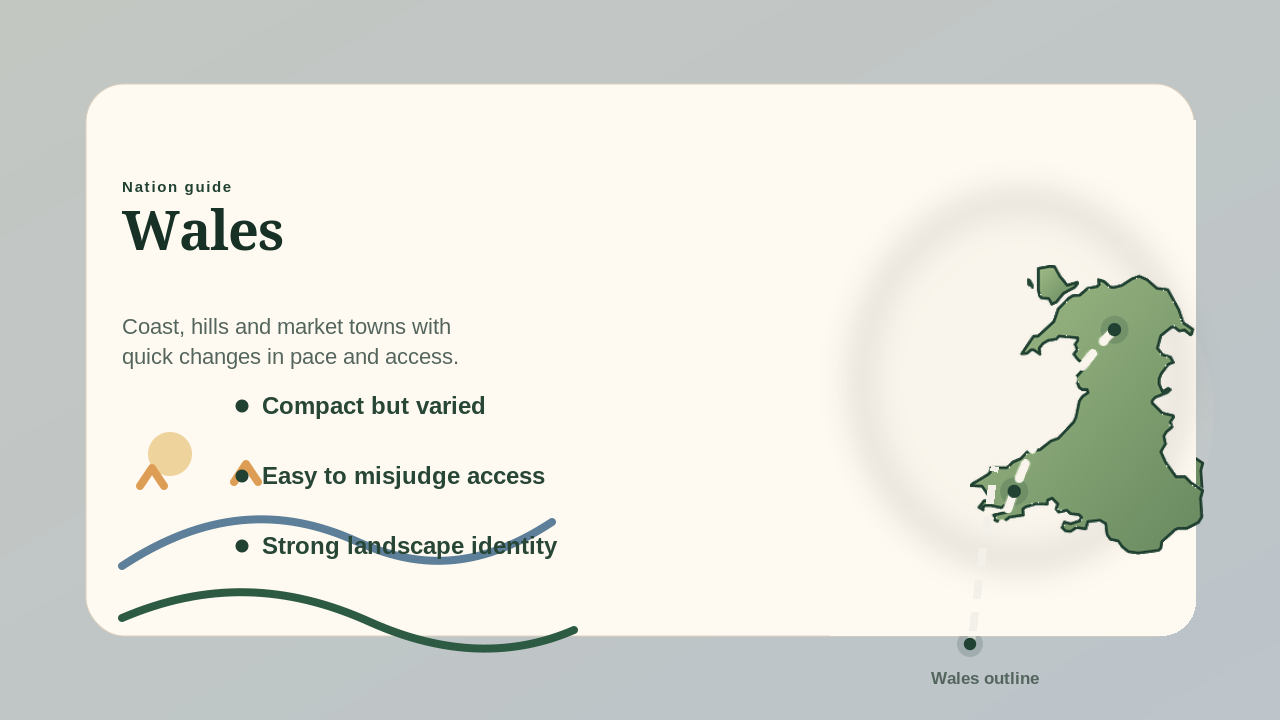
This is not a ranked list of best places in the abstract. The aim is to help you narrow the country into realistic move types. Areas are judged on everyday practicality, value for space, access to work and services, housing stock, landscape feel and whether the place still works outside the prettiest season.
You can still find strong scenery, room, character and a genuine change of pace without paying the same premiums as England’s best-known countryside hotspots. The trade-off is that practicality varies enormously. In Wales, the gap between “beautiful” and “easy to live in” can be wider than newcomers expect.
How to narrow Wales
Start with the south-versus-mid-versus-north decision. South Wales often makes the most sense if you still need jobs, services and occasional city access. Mid Wales suits readers who want much more countryside and are comfortable with thinner infrastructure. North Wales can be brilliant if your work and family geography line up, but it is not automatically the right fit for people whose lives still point toward the English cities.
Then ask what kind of countryside you actually want. Some people want a market town with proper shops and schools. Others want coast, mountains or a more self-sufficient feeling. Those are different moves, and Wales contains all of them.
Wales at a glance: which kind of Welsh move are you considering?
| Move shape | Usually strongest in | Best when | Main caution |
|---|---|---|---|
| Connected countryside | Monmouthshire and the south-east belt | You still want Cardiff, Bristol or the M4 corridor to feel usable | You can pay a lot for easy access while telling yourself you chose a total escape |
| Slower market-town life | Carmarthenshire, parts of Powys | You want a more obvious change of pace without total isolation | Some places feel peaceful on a first visit and inconvenient by month four |
| Coast and landscape pull | Pembrokeshire and selected north-coast belts | The outdoors is central to why you are moving | Popular beauty spots can feel stretched, expensive or seasonal |
| Value and breathing room | Less-hyped inland belts | You are willing to trade polish for room and calm | Readers sometimes confuse low noise with an easy fit |
Areas worth considering
1. Monmouthshire and the better-connected south-east belt
This is often the most obvious answer for people who want Wales without losing contact with Bristol, Cardiff or south-west England. It is attractive, relatively practical and easy to understand as a move. The downside is that the best bits are well known and priced accordingly.
2. Carmarthenshire
A strong all-round county for readers who want more rural feeling, useful market towns and a slower pace without going completely off the map. It often suits households who genuinely want to settle rather than just consume a lifestyle brand.
3. Pembrokeshire away from the obvious hotspots
Huge lifestyle appeal, especially if coast and outdoor life matter. The practical move here is usually to live near the beauty rather than in the most obviously precious places. That tends to give you more resilience day to day.
4. Powys and the mid-Wales market-town belt
This is the deeper countryside answer. You can find quiet, space and an entirely different tempo of life. It suits people who know that is what they want. It does not suit people who still need regular convenience but hope to improvise around it later.
5. Conwy, Denbighshire and the north-east fringe
Useful if north Wales makes sense for your work, family or emotional map. Some areas give you coast, hills and decent practical links. Others feel beautiful but are harder to live from than they first appear. Precision matters.
How Wales works best
| If you want… | Usually look at… | Watch out for… |
|---|---|---|
| Easy first countryside move | South-east Wales, Monmouthshire, edge-of-Cardiff areas | Paying a premium for a place that functions more like commuter countryside than true escape |
| Strong lifestyle without extreme remoteness | Carmarthenshire, parts of Pembrokeshire, selected market towns | Thin public transport and patchy services outside the better towns |
| Proper reset | Powys, deeper mid-Wales, quieter north Wales pockets | Underestimating distance, winter logistics and the emotional reality of thinner infrastructure |
Who Wales tends to suit best — and who it does not
Wales is often best for readers who want a countryside move that still feels distinctive and textured rather than polished and performative. It suits people who care about coast, hills, market towns and a more obvious sense of place. It is particularly good for readers who want beauty and practicality in the same conversation, not beauty first and logistics later.
People who want a strong landscape identity, a calmer pace and enough practical structure to keep daily life believable.
Readers who need seamless access everywhere and assume every rural move should feel frictionless. Wales rewards people who like texture; it frustrates people who expect polish.
Shortlist one connected south-east option and one slower inland or west-facing option. The contrast usually tells you what you really want.
The Welsh move often looks easier on a map than it feels in a week; road time, weather and pace matter more here than newcomers expect.
How to use this shortlist next
For a south-Wales commuter angle, go to Best Rural Areas Near Cardiff. For the nuts and bolts of house-hunting, read Questions to Ask When Viewing a Rural Property. For connectivity issues, see Internet in Rural UK.